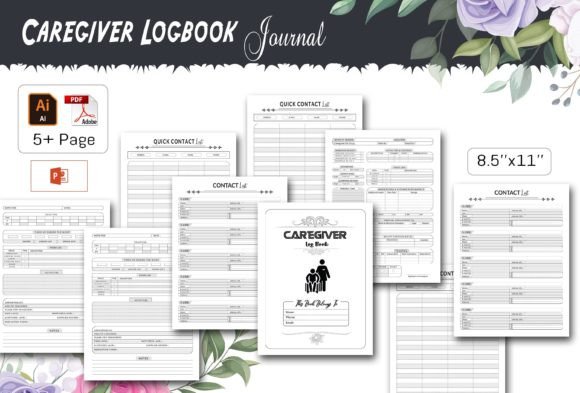
The Essential Caregiver Logbook Journal – Editable
For anyone navigating the complex responsibilities of caregiving, organization is not just a convenience—it's a necessity. A well-maintained log can streamline communication with medical professionals, track vital changes in health or mood, and provide a clear record for legal or financial purposes. This is where a thoughtfully designed Caregiver Logbook Journal – Editable becomes an indispensable tool. Unlike a static paper notebook, an editable digital journal offers the flexibility to adapt to the unique and evolving needs of your caregiving situation. However, choosing and implementing the right template requires careful consideration to avoid pitfalls that can render the tool ineffective or frustrating to use.
The Critical Mistake of Ignoring File Format Compatibility
One of the most common, and immediately frustrating, errors is purchasing or downloading a Caregiver Logbook Journal – Editable without verifying the software you actually own and use. The product description may list files like an Illustrator CC 2019 Ai file, a PowerPoint 2016 PPT file, and a PDF. Many assume that "editable" means they can easily tweak it in any program, but that's not the case. If you only have access to basic free software or a different version of PowerPoint, attempting to open a specialized Ai file will lead to a dead end.
This mistake directly impacts your efficiency and costs. You waste time trying to force a file to work, may need to purchase expensive software you don't fully understand, or ultimately abandon the editable features altogether, reverting to a manual, less efficient system. The better approach is to treat the listed file formats as your primary checklist. Before any purchase or download, confirm which application you are comfortable using. If you are proficient with Microsoft PowerPoint, the PPT file is your ideal starting point. If you have no graphic design software, the ready-to-upload PDF and included JPEG images might be your core assets, used for printing or simple digital insertion into other documents.
Overlooking the Practical Meaning of "Print-Ready" and "No Bleed"
The terms "print-ready" and "no bleed" are technical printing specifications that many beginners gloss over, assuming they simply mean "you can print it." This misunderstanding can result in poor physical presentation and wasted money at a print shop. A "print-ready" PDF, with a size of 8.5 x 11 inches and "no bleed," is formatted specifically for home or office printers. "No bleed" means the design elements stop at the edge of the page; there is no extra margin intended to be trimmed off. This is perfect for binding in a standard three-ring binder or using a simple home printer.
However, if you envision a professionally bound, glossy-covered book, a "no bleed" file is not the correct starting point. Professional print shops often require a "full bleed" design. Using the provided file for that purpose would lead to unsightly white borders on your final product. Conversely, attempting to add a bleed yourself without graphic design knowledge can distort the layout. The practical advice is to align your printing ambitions with the file's specifications. For quick, cost-effective, and functional logs, the provided no bleed PDF is excellent. For a premium bound journal, you would need to either commission a designer to modify the file or look for a product specifically offering bleed versions.
Misjudging the Scope of "Fully Editable Vector"
The inclusion of "100 vector shapes re-sizable" and "Fully Editable Vector" in a Caregiver Logbook Journal – Editable is a powerful feature, but its potential is often misunderstood. People might think it only allows changing colors or moving a few elements. In reality, vector graphics are mathematically defined shapes that can be resized to any dimension without any loss of quality. This means you can radically customize the journal's layout to fit specific needs—for instance, enlarging a medication chart section, removing a less relevant tracking box, or creating entirely new sections by combining and resizing the provided shapes.
The mistake is to treat the template as a fixed form, only filling in the blanks. This limits the journal's utility. A better approach is to spend an hour experimenting in the editable program (like PowerPoint or Illustrator). Try resizing a border, changing the font within a text box provided in the vector file, or duplicating a daily log page to create a weekly overview. This exploration unlocks a tool tailored precisely to the care recipient's routine, whether it requires extensive pain logging, simplified meal tracking, or prominent space for doctor's notes.
The Hidden Cost of Neglecting Output Quality: DPI and Image Includes
A detail like "High quality with 300 dpi" might seem irrelevant to a non-designer, but it is crucial for both digital and print clarity. DPI (dots per inch) determines the resolution. If you were to extract one of the included JPEG images and then stretch it beyond its intended size for a poster or a large display chart, a low-DPI image would become pixelated and blurry. The provided 300 dpi JPEGs ensure that if you use elements individually, they remain sharp.
Similarly, the "JPEG Image Includes" offer versatility. Perhaps you only need the medication schedule chart as a standalone image to email to a family member. Or you want to insert the daily mood tracker into a separate digital health app. Having these as individual, high-quality images allows for that. The oversight is to think of the product only as a monolithic five-page document. By recognizing the component parts, you increase the utility of your purchase, using its assets across multiple communication channels and formats.
Failing to Plan the Journal's Actual Use Case Before Editing
The excitement of having an editable file can lead to immediate, unplanned tinkering—changing colors, fonts, and layouts arbitrarily. While customization is the goal, doing so without a clear plan often results in a disorganized, harder-to-use journal. For example, changing every section to a different vibrant color might look creative, but it could make the log visually chaotic for daily use, reducing its functionality as a clear reference tool.
The corrective, practical step is to start with the ready-to-upload PDF. Use it as a physical or digital log for a week. This hands-on trial will reveal what sections are most valuable, which ones are lacking, and how the flow of information works for you and other caregivers. With that real-world data, your edits become purposeful. You might decide to mute the background colors for better readability, increase the font size for easier viewing, or add a dedicated line for evening vitals based on your observed need. This user-testing approach ensures your final customized Caregiver Logbook Journal – Editable is not just aesthetically personalized, but optimally functional.
What to Verify Before Your Final Decision
To ensure the Caregiver Logbook Journal – Editable you choose becomes a helpful asset, rather than a source of frustration, pause and check a few key points. First, match the software file formats (Ai, PPT) to the applications you own and can confidently operate. Second, clarify your primary output: immediate home printing for use in a binder, or professional printing for a bound book? This will dictate how you use the no bleed PDF. Third, consider the collaboration aspect. If multiple family members are contributing to the log, ensure the editable format you choose (like PowerPoint) is accessible to all, or that the PDF is easy to distribute and print for everyone. Lastly, view the "100 vector shapes" not as a marketing bullet point, but as a library of building blocks. Imagine how you could rearrange them before purchase, to confirm the template offers the fundamental components you need.
By approaching this tool with a focus on your specific practical requirements—your software, your printing method, your caregiving routine’s unique demands—you transform a generic template into a bespoke organizational system. The right Caregiver Logbook Journal – Editable, properly understood and implemented, saves time, reduces administrative stress, and creates a coherent, vital record that enhances the quality of care for everyone involved.