Migraine Headache Tracker: A Professional KDP Interior Solution for Creators
Tracking a migraine is more than noting a headache. It’s an intricate process of recording triggers, symptoms, duration, medications, and the broader impact on daily life. For millions of individuals, this data is crucial for managing a complex neurological condition. Meanwhile, a growing number of creators, entrepreneurs, and small business owners are seeking efficient ways to publish professional wellness tools. The Migraine Headache Tracker - KDP Interior bridges these two needs by offering a complete, editable journal template designed specifically for Amazon’s Kindle Direct Publishing platform.
The Shift Toward Personalized Health Management Tools
There is a significant movement towards personal accountability in health management. People are no longer passive patients; they are active participants using journals, apps, and logs to understand their bodies. This trend is fueled by a desire for concrete data to share with healthcare providers and a need to identify patterns that escape memory. A specialized migraine tracker journal fits perfectly into this modern approach, providing a structured yet flexible framework for consistent logging.
Traditional blank notebooks or generic planners often lack the specific prompts needed for effective migraine tracking. Users must create their own structure, which can be inconsistent and time-consuming. The demand for purpose-built tools has created a niche market for downloadable, printable, and publishable journal interiors. This is where KDP, or Kindle Direct Publishing, becomes a powerful avenue. It allows creators to design and sell physical notebooks without the overhead of large-scale printing, inventory, or distribution.
What Exactly Is a KDP Interior?
A KDP Interior refers to the complete, formatted inside pages of a book intended for print-on-demand through Amazon KDP. It is not the cover, but the body—the content a customer will write in or read. For a journal, this means all the pages, layouts, trackers, and instructions are pre-designed in a digital file. The Migraine Tracker Journal KDP Interior For Your Own Business package provides these ready-to-use files, enabling anyone to upload and publish a professional migraine journal without any design expertise.
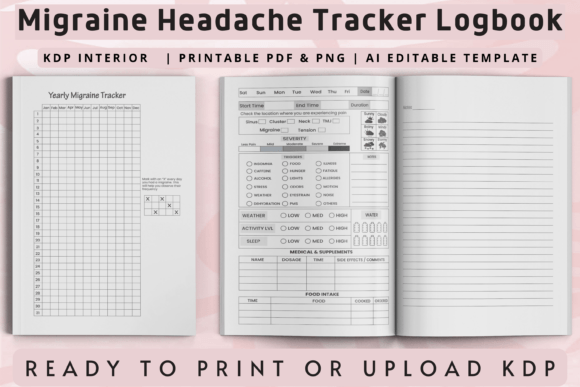
The value lies in the specificity and completeness. This interior includes dedicated yearly migraine tracker pages, allowing for long-term trend analysis over a full calendar year. With 120 total pages formatted for the standard 6x9 inches paperback size, it offers substantial capacity for detailed records. The design is validated on Amazon KDP, meaning it has been tested against Amazon’s printing specifications to ensure correct margins, bleed, and alignment—a critical technical step that many first-time publishers overlook.
The Practical Advantages for Creators and Entrepreneurs
Launching a physical product, especially a book, can be daunting. The “WHAT’S INCLUDED” list in this package directly addresses common hurdles. It provides three Adobe Illustrator editable source files. This is crucial for customization. A creator can modify colors, fonts, layout elements, or add their own branding before publishing. Illustrator files maintain high quality and scalability, offering true professional control.
Additionally, the package includes three high-quality JPG files and a PowerPoint file. These formats offer flexibility for different user needs. The JPGs can be used for quick previews or in other publishing software, while the PowerPoint file provides an accessible option for those who prefer a simpler platform for minor edits. This multi-format approach accommodates a wide range of technical skill levels, from advanced designers to beginners.
The state of being “Ready To Upload KDP” is the ultimate convenience. It means the core interior files are already configured to meet KDP’s stringent requirements. This eliminates hours of technical troubleshooting and formatting guesswork, allowing the entrepreneur to focus on marketing, branding, and business strategy rather than page setup errors. It transforms a complex publishing project into a streamlined workflow.
Meeting Modern User Expectations for Wellness Products
Today’s consumers expect wellness tools to be both functional and aesthetically pleasing. A migraine journal must be easy to use daily, with clear sections and logical flow, but it should also feel inviting and calm—a product that doesn’t add stress to the user’s experience. A professionally designed interior addresses this duality. The included editable files allow creators to adapt the visual design to match current market preferences, whether that’s minimalist, therapeutic, or vibrant.
The evolution of self-care from a luxury to an integrated part of daily routine has expanded the market for such niche journals. Professionals, freelancers, and busy individuals who experience migraines are looking for tools that seamlessly fit into their organized lives. A 6x9 inch, 120-page journal is portable enough for a work bag or bedside table, yet substantial enough to feel like a dedicated, serious tool for health management.
How This Fits into the Creator Economy and Side Business Trends
The rise of the creator economy has empowered individuals to turn skills and interests into micro-businesses. Bloggers, educators, marketers, and even healthcare professionals can leverage their knowledge by publishing complementary tools. A migraine sufferer with a blog about health could publish this journal as a companion product. A graphic designer can use the editable source files to quickly create a branded version for their portfolio or client work.
This product exemplifies the shift toward digital assets as business foundations. Instead of manufacturing products in bulk, creators can purchase a ready-made digital interior, customize it, and sell it through a global print-on-demand service. The risk is low, the startup cost is minimal, and the potential for recurring revenue exists, especially if one builds a brand around health tracking. It aligns perfectly with modern entrepreneurial habits that value agility, digital goods, and passive income streams.
The package’s validation on Amazon KDP is a key selling point for serious creators. It acts as a quality assurance, indicating that the files have passed practical testing. This reduces the fear of negative customer reviews due to printing flaws or poor layout, which is essential for building a trustworthy business on platforms like Amazon.
Realistic Applications and Recommendations
For a user interested in publishing, the process is straightforward: acquire the interior package, open the Illustrator files to apply any custom logos or color schemes, then upload the final PDF to KDP alongside a designed cover. The journal can be listed for sale globally, with Amazon handling printing, shipping, and customer service.
For the end-user—the person who buys the published journal—the benefit is a coherent tracking system. The yearly migraine tracker pages allow them to see seasonal patterns, correlate events with lifestyle changes, and provide their doctor with a year’s worth of data instead of fragmented notes. This can lead to more personalized and effective treatment plans.
It’s important to approach this opportunity with realistic expectations. Success depends on effective marketing, understanding the target audience of migraine sufferers and health-conscious individuals, and possibly combining the journal with informative content or a supportive community. The product itself is a high-quality tool, but its commercial success hinges on how it is positioned and presented to a niche market that values specificity and design.
Ultimately, the Migraine Headache Tracker - KDP Interior represents a thoughtful convergence of a genuine health need and a viable business model. It provides a structured solution for individuals seeking to understand their migraines while offering creators a polished, tested, and adaptable product to bring to market. This dual-purpose utility makes it a relevant and practical asset in today’s landscape of personalized health and independent entrepreneurship.