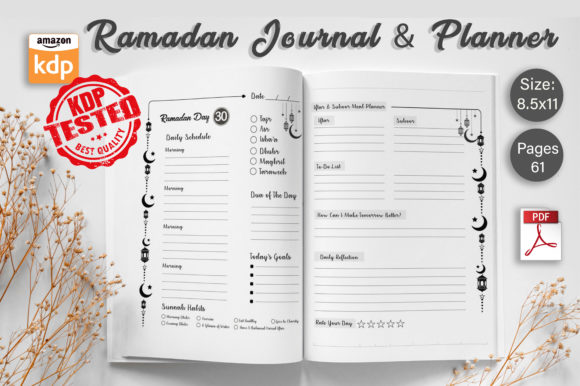
Your Ultimate Ramadan Planner Journal
Imagine having a beautifully structured, professionally designed journal that guides your spiritual journey and daily reflections throughout Ramadan, ready to publish and share.
This Ramadan Planner Journal stands as a prime example of how thoughtful design and practical usability converge in a low-content book interior. For graphic designers, content creators, and entrepreneurs exploring the creative marketplace, such resources exemplify the power of a well-executed visual design system. It transforms a simple journal into a cohesive, user-friendly experience, elevating both the creator’s workflow and the end-user’s engagement.
Design That Supports Purpose
At its core, this journal is a tool for organization and mindfulness. Its effectiveness hinges on its design—the visual communication that guides the user. A clean layout with intentional visual hierarchy ensures that daily entries, prayer tracking, and goal-setting sections are easily navigable. This clarity is paramount in any design project, whether it’s a digital planner, a brand identity system, or a complex web design. The journal’s structure demonstrates how editorial design principles can be applied to create documents that are not only functional but also aesthetically calming and inspiring.
Key Visual Elements in Practice
The chosen graphic design elements work in unison to create a premium feel. Consider the importance of a consistent color palette; here, the availability in both colour and greyscale offers flexibility for different printing preferences and design moods. Typography choices influence readability and tone, crucial for any printed material meant for daily use. The inclusion of an intro page establishes a branded entry point, a concept directly transferable to branding and logo design where a strong first impression is vital.
- Scalability: Offered in two standard print sizes (8.5″ x 11″), it highlights how adaptable formats support broader market applications.
- Production-Ready: Being a KDP-tested, no-bleed, print-ready PDF file underscores the necessity of technical precision in print design and digital product creation.
- User-Centric Layout: The 61-page count is thoughtfully planned, avoiding clutter and focusing on essential sections, a lesson in UX design and information architecture.
Applications Beyond the Pages
The value of this design extends far beyond the physical journal. For designers and marketers, it serves as a case study in creating versatile creative assets. The same principles used here—clean composition, a restrained color palette, and a focus on usability—can directly inform other projects:
Think of adapting its structured elegance for social media graphics that guide a community through Ramadan, or for website UI design that requires clear, calming navigation. Its layout can inspire packaging design for related products, or the template’s framework can be a springboard for advertising campaigns and professional presentations that need a logical flow. This journal isn't just a product; it’s a source of design inspiration for merchandise, digital products, and overall brand identity systems that require a harmonious blend of form and function.
Integrating Design into Your Workflow
Selecting and utilizing such a template effectively requires a designer’s eye for detail. Evaluate it not just as a finished product, but as a collection of reusable design components. How do the section dividers establish visual hierarchy? How does the spacing affect readability and user experience? When integrating it into a larger brand system, consider its compatibility with existing typography and color schemes to maintain consistency across all touchpoints—from digital marketing to print design.
The ultimate goal is to enhance communication through aesthetics. A well-designed Ramadan planner journal does more than organize days; it communicates serenity, intention, and support through its visual language. This is the hallmark of successful graphic design: solutions that are beautiful, purposeful, and profoundly useful.
In any creative project, from a simple printable to a complex brand rollout, the commitment to quality creative assets—where every line, space, and color serves a clear purpose—is what separates amateur output from professional presentation. Investing in and understanding such resources fundamentally improves your design workflow and the impact of your final creations.