The Essential Guide to Tracking Your Crochet Projects: Understanding the Crocheting Log Book
For any dedicated crocheter, from the hobbyist to the professional, managing a growing portfolio of projects can become surprisingly complex. Keeping track of yarn types, hook sizes, pattern modifications, and project timelines is crucial for both personal satisfaction and professional consistency. In this context, specialized tools have emerged to streamline this process, chief among them the Crocheting Log Book. This article explores the nature, utility, and comparative value of a structured Crocheting Log Book, helping you determine if it aligns with your creative workflow.
What is a Crocheting Log Book and What Makes It Distinct?
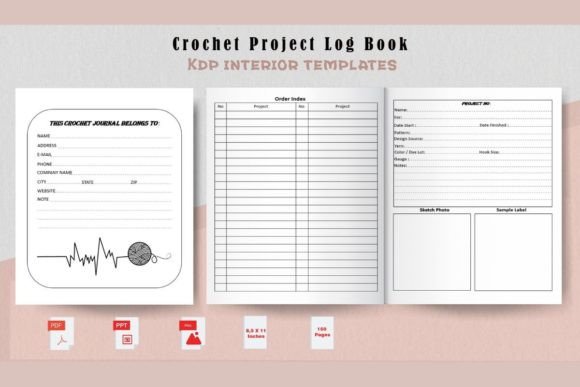
A Crocheting Log Book is a dedicated organizational tool designed to systematically record the details of your crochet projects. Unlike a generic notebook or scattered digital notes, its structure is specifically tailored to the craft's requirements. It typically includes sections for logging project names, start/end dates, yarn brand and color, hook size, stitch patterns, gauge, and notes on modifications or challenges. Its primary distinction lies in its intentional design: it transforms project tracking from an ad-hoc activity into a standardized, repeatable process.
The inherent value of a Crocheting Log Book is its function as a centralized knowledge repository. Over time, it becomes a personalized reference guide. You can consult past entries to recall how a particular yarn behaved, how many skeins a similar-sized blanket required, or which hook size achieved the desired drape for a garment. This moves beyond simple memory into documented experience, which is especially valuable for those who crochet intermittently or work on many concurrent projects.
Comparing Documentation Approaches: From Analog to Digital
When considering how to track crochet work, crafters generally gravitate toward a few broad approaches, each with its own set of trade-offs.
Generic Notebooks and Scrap Paper
The most informal method is using whatever paper is at hand. This offers maximum flexibility and zero upfront cost. However, the strengths of flexibility are countered by significant limitations in organization. Information becomes scattered, difficult to retrieve, and often incomplete. Comparing projects across time requires sifting through disjointed notes. For a crafter with only a handful of simple projects, this may suffice. But for anyone seeking growth, refinement, or efficiency, the lack of structure becomes a hindrance.
Digital Apps and Spreadsheets
Some crafters utilize digital tools, like note-taking apps, spreadsheets, or even specialized craft apps. These offer powerful searchability, cloud backup, and the ability to include digital photos easily. The trade-offs often involve a learning curve, the potential for data entry to feel more "technical" than creative, and sometimes a dependency on devices or subscriptions. The tactile, offline nature of crochet itself can contrast sharply with a purely digital logging system.
The Structured Log Book: A Balanced Alternative
A pre-designed Crocheting Log Book occupies a middle ground. It provides the tangible, tactile experience of a notebook—which often complements the hands-on craft—but with the guided structure of a digital form. Its physical format means no batteries or login required, offering a permanent, offline archive. The predefined sections prompt you to record consistently useful data, reducing the chance of omitting key details. Compared to a generic notebook, it offers organization; compared to a digital system, it offers simplicity and direct tactile engagement. However, its fixed structure may feel restrictive to those who require highly customized data fields.
Evaluating a Ready-Made Template: The Crochet Journal Log Book
For those who appreciate the log book concept but lack the time or design skills to create one from scratch, ready-made interior templates become a practical consideration. An example is a Crochet Journal Log Book KDP Interior Template offering immediate download with PDF files ready for print and PowerPoint source files for customization. Such products highlight specific features that address common user needs.
The stated dimensions of 8.5" x 11" provide a standard, easy-to-print size compatible with home printers or professional services. A 150-page count offers substantial capacity for numerous projects, while the "No Bleed" specification indicates it's optimized for simple, margin-aware printing without complex formatting. The inclusion of a print-ready PDF file ensures you can produce a physical book quickly. Perhaps more significant for comparison-aware users are the source files: access to PDF, PNG, and PPTX formats allows for modification. This means you can adjust headings, add or remove pages, or insert your own branding before printing, blending the benefits of a pre-structured template with some degree of personalization.
Key Decision Factors for Template Use
When evaluating such a template against creating your own log book from scratch or using another method, several factors come into play.
- Time Investment: Designing a log book layout requires time and effort. A template provides an instant starting point, which is a major advantage for those who want to begin logging immediately.
- Printing Convenience: A professionally formatted, print-ready PDF eliminates worries about margins, page alignment, and image quality. This is crucial for those who plan to physically bind and use the book.
- Customization Flexibility: The availability of PowerPoint source files is a critical feature. It allows you to tailor the template to your exact needs, perhaps adding a section for yarn inventory or project cost calculations. If no source files are provided, the template is essentially static, which may be a limitation for some.
- Cost vs. Value: A template is typically a low-cost digital product. The value hinges on whether its predefined structure matches your logging style and whether the customization options meet your adjustment requirements.
Identifying the Best-Fit Situations for a Crocheting Log Book
A Crocheting Log Book, particularly one built from a well-designed template, is not the universal solution for every crocheter. Its utility is highest in specific scenarios.
It is likely the right choice for intermediate to advanced crafters who undertake multiple or complex projects annually. It serves beautifully as a business tool for crochet artists selling their work, as it provides documented consistency for replicating items and tracking material costs. It also fits those who enjoy the analog process and wish to build a tangible archive of their craft journey—a book that can be browsed years later, separate from digital devices.
Conversely, a dedicated Crocheting Log Book may be less essential for absolute beginners focused on mastering basic stitches on single projects. Their documentation needs might be minimal. Similarly, crafters who exclusively prefer digital ecosystems—integrating project photos, online pattern links, and cloud sharing—might find a physical log book an unnecessary duplicate. For them, a robust digital note-taking system or spreadsheet might be a more congruent alternative.
Strengths and Practical Limitations
Understanding the inherent trade-offs helps in making an informed decision.
The strengths of a physical Crocheting Log Book are clear: it fosters disciplined recording, creates a lasting physical artifact of your work, and simplifies reference lookup without software. Using a template amplifies these strengths by adding professional layout and immediate usability.
The limitations are equally important to consider. A physical book cannot be easily backed up unless duplicated; loss or damage means lost data. It lacks the instantaneous search function of a digital database. While customizable templates mitigate rigidity, there is still a framework you must work within. Furthermore, if your projects require extensive photographic documentation, a physical log book relies on printed photos or separate digital storage, creating a hybrid system that some may find disjointed.
Moving Toward an Informed Choice
Selecting a project tracking method is a personal decision based on your craft's scale, your preferred working style, and your future goals. A Crocheting Log Book, especially one derived from a customizable template, offers a compelling blend of structure, tangibility, and focused utility. It systematizes what many crafters already try to do informally, turning project notes into a valuable, consolidated resource.
Before committing, assess your own habits. Do you currently jot notes that you later cannot find? Do you often repeat projects and struggle to recall exact details? Do you value having a non-digital hobby companion? If so, exploring a Crocheting Log Book template could significantly enhance your creative process. If your workflow is deeply integrated with digital tools and you require advanced data manipulation or sharing, you might weigh the log book against a digital system you can build yourself. Ultimately, the goal is to choose a tool that supports your craft without adding unnecessary complexity, allowing you to focus on the joy of creation itself.