The Essential Tool for Modern Homeowners: Mastering Your Property with a Home Maintenance Log Book
In the rhythm of modern life, our homes are more than just structures; they are complex systems, investments, and sanctuaries. Managing this asset proactively has become a critical skill, merging personal responsibility with financial prudence. This is where the concept of a dedicated Home Maintenance Log Book transitions from a simple notebook to a strategic organizational tool. It represents a systematic approach to property care, a tangible record that empowers homeowners to track, plan, and execute the ongoing maintenance essential for preserving value and ensuring safety.
Beyond the Checklist: The Home Maintenance Log Book as a Central Command
A Home Maintenance Log Book is not merely a list of chores. It is a centralized repository for the entire lifecycle of your home's upkeep. Imagine a single, organized volume where you log seasonal tasks, record repair dates and contractor details, track appliance service histories, note warranty expiration dates, and schedule future inspections. This consolidation replaces scattered sticky notes, forgotten digital reminders, and misplaced invoices. It creates a coherent narrative of your home's health, transforming reactive fixing into proactive stewardship.
This tool fits seamlessly into broader trends of data-driven living and asset management. In an era where we track our fitness, finances, and projects digitally, the physical home—a significant, tangible asset—often lacks a comparable system. The log book bridges this gap, applying principles of personal analytics and project management to the domestic sphere. For professionals, entrepreneurs, and busy families, it formalizes home care into a manageable workflow, reducing cognitive load and preventing costly oversights.
Why the Home Maintenance Log Book is Gathering Attention
The heightened attention to tools like a Home Maintenance Log Book stems from several converging shifts in lifestyle, economics, and technology. First, there is a growing awareness of homeownership as a long-term financial portfolio item. Regular maintenance is directly linked to asset valuation, insurance requirements, and resale potential. A documented history of care is invaluable during property assessments or sales.
Secondly, the "DIY" and home improvement culture, amplified by digital media, has encouraged more hands-on engagement. People are not just hiring out every task; they are learning, planning, and executing projects themselves. A log book serves as their project planner and knowledge base, recording lessons learned, paint colors used, and part numbers purchased.
Furthermore, the rise of remote work and heightened focus on domestic space has increased the perceived importance of a well-functioning, comfortable home. Its systems—HVAC, plumbing, electrical—are now integral to daily productivity and well-being. Tracking their maintenance ensures this crucial environment remains reliable.
Changing Needs and the Rise of Systematic Home Management
Contemporary homeowners and renters alike exhibit changing expectations. The preference is shifting from ad-hoc, memory-based management to organized, documented systems. This reflects a broader desire for control and predictability in complex environments. A Home Maintenance Log Book meets this need by providing structure.
Consider practical examples: tracking the last filter change for your HVAC system can improve air quality and efficiency; logging a roof inspection date can inform insurance discussions; noting the lifespan of a water heater allows for planned replacement before a catastrophic failure. These observations move home care from a realm of stressful surprises to a domain of scheduled, budgeted operations. It connects to larger developments in smart home technology as well—while devices automate functions, the log book provides the human-curated record and strategic oversight that technology cannot.
Integration into Professional and Creative Workflows
For creators, freelancers, and professionals who often manage multiple projects, the principles of workflow organization are paramount. Applying these principles to home maintenance is a natural extension. A well-designed log book uses clear sections, actionable tables, and calendar views, mirroring professional project management tools. It allows for delegation—family members or contractors can be assigned tasks logged in the book—and provides a clear history for tax or deduction purposes related to home office improvements.
The relevance for entrepreneurs and marketers is particularly insightful. The discipline of maintaining a key asset (the home) parallels maintaining a business asset. The log book encourages regular review ("quarterly maintenance check"), preventative action, and cost analysis, fostering a mindset that is directly transferable to business operations. It turns a personal responsibility into a practice in operational excellence.
A Solution Designed for Implementation: The Ready-to-Use Log Book
Understanding the need is the first step; having the right tool for implementation is the next. A purpose-built Home Maintenance Log Book, designed for instant use, eliminates the friction of creating a system from scratch. This is where a professionally crafted digital product becomes invaluable.
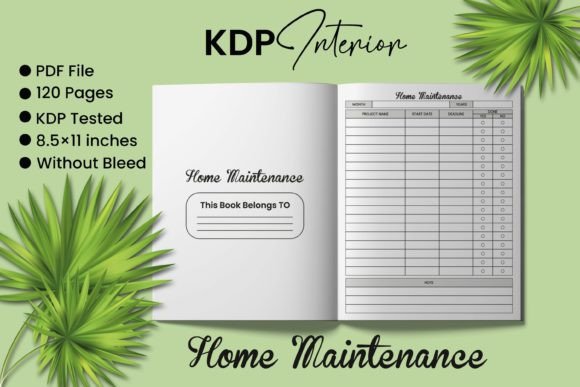
Imagine downloading an exclusive Home Maintenance Log Book KDP Interior package, ready for immediate application. This comprehensive resource provides a structured, high-quality foundation. You receive a single ZIP file containing a print-ready, 120-page interior formatted to standard 8.5×11 inches. The package includes a high-resolution 300 DPI PDF file for printing or digital use, a JPG file for visual reference, and a dedicated intro page. The interior is meticulously prepared without BLEED, ensuring compatibility and a clean, professional layout. Crucially, these files are compressed and READY TO UPLOAD to platforms like Amazon KDP (Kindle Direct Publishing), having been tested to ensure quality and adherence to platform specifications.
This practical solution aligns perfectly with the insight-driven approach to home management. It offers not just a concept, but a tangible, contextual tool that integrates directly into the user's workflow. By providing a semantic structure—sections for annual schedules, emergency contacts, appliance inventories, and repair logs—it uses terminology and design that naturally guide the homeowner through the comprehensive process of maintenance tracking.
The Forward-Looking Perspective: An Investment in Order and Value
Adopting a systematic approach with a Home Maintenance Log Book is a forward-looking practice without speculation. It is an investment in order that pays dividends in saved time, avoided emergencies, preserved property value, and personal peace of mind. As homes incorporate more technology and as life places greater emphasis on the quality of our living spaces, the role of disciplined maintenance will only grow. Having a dedicated log book positions the homeowner not as a passive occupant, but as an active, informed manager of their most significant physical asset.
In conclusion, the movement towards organized home maintenance is a reflection of modern priorities: control, efficiency, and long-term planning. The Home Maintenance Log Book is the keystone of this movement, a simple yet profound tool that transforms chaos into calendar, worry into workflow. For the professional, the creator, the enthusiast, and every homeowner who views their dwelling as a legacy and a livelihood, embracing this tool is a step toward mastering the art and science of home stewardship.