Your Ultimate Library Book Tracker
Imagine you’re standing at the self-checkout machine at your local library, scanning your stack of finds. You feel that familiar mix of excitement and mild anxiety. Which book has a three-week loan? Which DVDs need to be back in seven days? You promise yourself you’ll remember, but life gets busy, and those due dates can blur. A Library Book Tracker is the simple, elegant solution to this universal reader’s dilemma. It’s more than just a list; it’s a dedicated system to manage your borrowed materials, ensuring you never miss a return date and maximizing your library’s incredible free resource.
Where and Why a Library Tracker Becomes Essential
For avid readers, parents with kids in reading programs, students researching projects, or even casual audiobook listeners, the library is a hub of constant activity. The challenge isn’t accessing the books—it’s managing the logistics of borrowing. A Library Tracker shines in these everyday situations. Consider the homeschooling parent who checks out thematic books every fortnight. Without a clear record, books from one batch can easily mix with the next, leading to overdue fines and organizational chaos. Or the professional researching a new market trend, borrowing several industry reports and business books. Keeping track of which source needs to be returned first allows for focused study time without the nagging worry of administrative oversight.
The real benefit lies in transforming a public service into a seamlessly personal system. It turns the guilt of an overdue fine into the satisfaction of a well-managed hobby. It replaces frantic searches through emails or memory for due dates with a quick glance at a purposeful planner. This isn’t about complex library science; it’s about bringing order to a wonderfully free but often fluid process.
Adapting the Tracker to Your Lifestyle and Needs
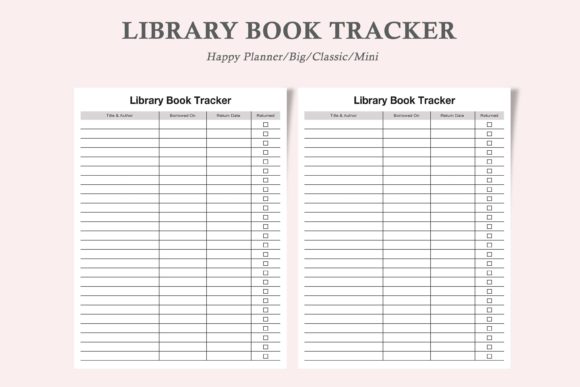
A great tool adapts to the user, not the other way around. This is why the availability of the Library Book Tracker in three distinct sizes—Big, Classic, and Mini—is a critical feature, not just a technical detail. Each size serves a different real-world application.
The Happy Planner Big size (8.5” x 11”) is ideal for the central family command center or a dedicated reading journal binder. A parent might print a page and post it on the fridge, making the family’s library borrows a shared, visible responsibility. A book club organizer could use it to track not only their own loans but also titles discussed each month, creating a master reference document.
The Happy Planner Classic (7” x 9.25”) fits perfectly into a standard planner binder carried by students, educators, and freelance creatives. A university student can have a section in their academic planner specifically for research library books, coordinating due dates with assignment deadlines. A novelist using the library for historical research can keep this tracker alongside their writing notes, ensuring reference materials are available as long as needed.
The Happy Planner Mini (4.5” x 7”) is the portable powerhouse. Slip it into a purse, a laptop bag, or even a coat pocket. This is for the on-the-go reader. Imagine you’re at the library after work, and you spontaneously pick up a few novels. You can immediately jot them down in your compact Library Book Tracker before you even leave the building. It’s also perfect for tracking children’s quick-read books, where the volume might be high but the loan period short.
Connecting Features to Real Outcomes
The “Professional, minimalist, ink-friendly design” is a practical mercy. It means you aren’t wasting ink on decorative graphics when you print a new page, and the clean layout makes information easy to scan quickly. The ability to “Print a new page every time you need more” aligns perfectly with how library usage actually works—in bursts and cycles. You don’t need a permanent, pre-paginated book; you generate a fresh sheet when you embark on a new borrowing spree, keeping your record current and uncluttered.
And since it’s a Digital Download, you acquire it instantly. There’s no wait for shipping. You can solve your library management problem the very moment you realize you need a system. The included PDF and JPEG formats offer flexibility; use the PDF for crisp, guaranteed-format printing, or utilize the JPEG if you prefer to incorporate the tracker into a digital photo album or note-taking app on a tablet.
Scenarios Across Personal and Professional Life
Let’s walk through a few more concrete scenarios where this tracker moves from being a nice idea to a daily asset.
For the Blogger or Content Creator focusing on book reviews, a Library Book Tracker acts as a production schedule. They can plan which review titles are coming up, note their due dates to prioritize reading, and ensure they return books promptly to maintain good library standing—all crucial for a steady, cost-effective content pipeline.
An Educator or Tutor using the library to supplement curriculum materials can track books by subject unit. When the unit on ecosystems ends, they know exactly which field guides and children’s science books need returning, making room for the next unit’s resources. It systematizes their educational tool rotation.
Small Business Owners or Entrepreneurs often use libraries for market research, legal guides, or inspirational biographies. Mixing these with personal leisure reads can lead to confusion. A dedicated tracker separates the “business borrows” from the “pleasure borrows,” helping manage time and responsibility. A due date for a critical business law book gets the attention it deserves.
Even for the Hobbyist—the cook borrowing cookbooks, the artist checking out technique guides, the gardener looking for plant manuals—the tracker helps them explore a topic deeply without losing track of their borrowed foundation materials.
What to Consider Before Using a Library Book Tracker
Implementing any new system requires a tiny moment of reflection. First, consider your primary borrowing pattern. Do you visit the library weekly in a structured way, or is it more sporadic? The sporadic borrower benefits hugely from a tracker, as memory is less reliable. Next, think about your physical or digital organization style. Do you prefer a binder on a desk, a sheet on the fridge, or a small planner in your bag? Choosing the Big, Classic, or Mini size should match this existing habit, not fight it.
Also, acknowledge if you share library resources with family members. A single, centrally located Big tracker might serve the whole household better than individual mini trackers. Finally, assess your printing access. The digital download model means you need a way to print the pages. If you print regularly at home or work, it’s seamless. If you rely on library or store printing, you might want to print several sheets in one visit to have them ready.
The goal is to make your library visits more joyful and less stressful. A Library Book Tracker isn’t about adding bureaucracy to reading; it’s about removing the small annoyances that can detract from the pleasure of borrowing books. By giving you a clear, adaptable, and tangible record, it puts the focus back on discovery and learning, while the logistics quietly, reliably, handle themselves.