Mastering Academic Success: The Strategic Role of an Assignment Planner Log Book
In the demanding landscape of education, from high school to postgraduate studies, the management of multiple assignments, deadlines, and research tasks can become a significant source of stress. While digital calendars and task apps offer one solution, many students and professionals find that a dedicated, physical tool provides a uniquely effective method for cognitive organization and accountability. This is where the concept of an Assignment Planner Log Book comes into play, transforming chaotic academic workloads into structured, manageable processes.
The Anatomy of a Purposeful Planner
An Assignment Planner Log Book is not merely a notebook. It is a specialized instrument designed to track, deconstruct, and schedule academic work. Its structure typically moves beyond simple date listings to include sections for breaking down assignments into constituent steps, logging research sources, monitoring progress, and reflecting on challenges and solutions. The physical act of writing in such a log engages different cognitive processes than typing on a screen, often enhancing memory, commitment, and clarity of thought.
Characteristics of a well-designed log book include clear layout segmentation, ample space for detailed notes, and a format that encourages forward planning. For instance, a single assignment entry might encompass the initial brief, a brainstorm of ideas, a list of required resources, a step-by-step timeline from research to drafting to final review, and a final section for instructor feedback and self-evaluation. This holistic view turns an assignment from a monolithic deadline into a series of achievable, sequential tasks.
Key Advantages Over Generic Planning Methods
The primary benefit of using a dedicated Assignment Planner Log Book is the consolidation of all academic work into a single, authoritative source. This eliminates the fragmentation that occurs when using disparate tools—a due date in a digital calendar, notes in a random notebook, resource links saved in a browser. Consolidation reduces mental clutter and the risk of overlooking critical components.
Furthermore, such a log book promotes proactive rather than reactive management. By requiring the user to plan the steps needed to complete a task, it forces engagement with the assignment's scope well before the deadline looms. This early engagement can surface questions or resource needs early, allowing time for resolution. Another significant advantage is the creation of a tangible record of effort and progress. Filling the pages provides visual motivation, and reviewing past completed assignments builds confidence and offers a reference for similar future work.
Diverse Users and Real-World Applications
The utility of an Assignment Planner Log Book extends across a broad spectrum of users. Undergraduate students juggling multiple courses per semester are obvious beneficiaries, but the tool is equally valuable for postgraduate researchers managing complex, long-term projects like dissertations. Here, the log can track literature review progress, data collection milestones, and chapter drafting schedules over months or even years.
Educators and instructors themselves can employ a version of this tool to plan coursework, assignment design, and grading timelines. Professionals undertaking continued education or certification courses while working full-time find it indispensable for balancing occupational and academic demands. Even hobbyists engaged in self-directed learning projects use such logs to structure their exploration and maintain momentum. The common thread is the need to decompose a large intellectual undertaking into trackable, actionable units.
Integrating the Log Book into a Productive Workflow
Effective use of an Assignment Planner Log Book involves integrating it into a daily or weekly review ritual. A recommended workflow begins with a "master dump" upon receiving a new syllabus or project outline: logging every known assignment, its final due date, and any provided details. Subsequently, each assignment undergoes a "planning session" where it is broken down. Questions like "What is the first piece of research I need?" or "When must the first draft be completed?" are answered, and these sub-tasks are scheduled onto specific dates.
The log then becomes a daily touchpoint. Each study session starts with consulting the log to see what micro-task is scheduled for that day. After working, progress is recorded, and any newly discovered next steps are added. This cyclical process—plan, execute, log, review—creates a closed-loop system that minimizes ambiguity and wasted effort. The log also serves as a communication tool; a clearly planned breakdown can be used to discuss timelines with instructors or collaborate with peers on group projects.
Critical Considerations for Selection and Use
When adopting an Assignment Planner Log Book, certain considerations enhance its effectiveness. The physical format must suit the user: size, layout, paper quality, and binding. Some prefer ample space for free-form notes, while others thrive with highly structured tables and prompts. The key is that the tool should feel inviting and usable, not cumbersome.
Another consideration is the balance between planning detail and flexibility. Over-planning every minute can be as counterproductive as under-planning. The log should allow for adjustments as assignments evolve. Including sections for reflection—what worked, what didn’t—turns the log into a tool for continuous improvement in one's academic methodology. Importantly, the log book is a supplement to, not a replacement for, engagement with course material and instruction; it organizes the effort, not the learning itself.
The Digital Complement and the KDP Opportunity
While the core value lies in the physical artifact, the digital realm plays a supporting role. Many users scan or photograph completed log pages for cloud backup. Furthermore, the creation and distribution of these specialized tools has been revolutionized by platforms like Amazon KDP (Kindle Direct Publishing). This allows creators, educators, or even experienced students to design and publish their own optimized Assignment Planner Log Book interiors, tailoring them to specific fields of study or planning philosophies.
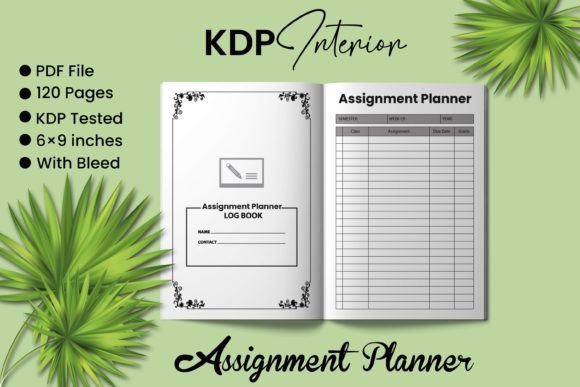
For those interested in creating such a tool, a ready-to-use, high-quality KDP interior file offers a significant head start. A professional interior typically includes features like a 6x9 inch trim size optimized for readability, a high-resolution 300 DPI PDF file ensuring crisp print quality, an introductory page guiding the user, and a complete 120-page structure with proper technical setup like BLEED for clean edges. Such files, compressed into a ZIP file and pre-tested for KDP upload, allow creators to focus on content and marketing rather than complex graphic design and technical specification.
Observed Outcomes and Long-Term Value
Observations from users who consistently employ an Assignment Planner Log Book often highlight reduced last-minute panic and improved assignment quality. The step-by-step approach mitigates the temptation to cram, leading to more thoughtful research and polished writing. There is also a notable improvement in the ability to estimate time requirements for future tasks, a skill that transfers directly to professional project management.
The long-term value extends beyond graduation. The completed log books become archives of academic effort, useful for portfolio reviews or application processes. More importantly, the user cultivates a disciplined, structured approach to handling complex tasks—a meta-skill applicable to virtually any career path. The Assignment Planner Log Book, therefore, is more than a study aid; it is a training device for systematic thinking and personal accountability.
In essence, the decision to use an Assignment Planner Log Book represents a commitment to taking conscious control of one's academic workload. It is a practical rejection of chaos and procrastination. Whether using a pre-made book or a customized version created via a downloadable KDP interior, the tool's power lies in its ability to make the abstract concrete, the overwhelming manageable, and the stressful orderly. For anyone navigating the challenging waters of academic or self-directed learning, it provides not just a log, but a map and a compass.