Understanding the Role of a Learner's License Driving Log Book
For anyone embarking on the journey to obtain a full driver's license, documenting practice hours is a crucial step mandated by many licensing authorities. A Learner's License Driving Log Book serves as the official record of this experience, providing a structured format for learners to track their driving time, conditions, and skills progression. Unlike a simple notebook or digital note, a professionally designed log book formalizes this process, ensuring compliance with regulatory requirements and creating a valuable personal record of your learning journey. Its primary distinction lies in its purpose-built layout—typically including fields for date, duration, type of practice, supervising driver details, and notes on skills practiced or routes taken.
Comparing Recording Methods: Digital vs. Physical Logs
When considering how to track driving hours, prospective drivers often evaluate different approaches. Digital options range from basic spreadsheet templates to dedicated mobile apps. These can offer convenience, automatic calculations, and easy sharing. However, a physical Learner's License Driving Log Book presents several comparative advantages. It requires no batteries or software, eliminating concerns about device availability or data entry errors in the moment. For many supervising drivers—often parents or mentors—a tangible book can feel more authoritative and simpler to verify and sign after each session. The act of manually writing entries can also reinforce memory and engagement with the learning process.
Conversely, digital tools might be better suited for individuals who are highly tech-integrated and prefer to consolidate all records in one device. The tradeoff here involves reliability versus convenience. A physical log book won't suffer from a crashed app or a forgotten login, but it can be misplaced. Your choice may depend on your personal organizational habits and the preferences of your supervising driver.
Key Features of a Comprehensive Driving Log
A well-designed Learner's License Driving Log Book goes beyond mere rows and columns. To be truly useful, it should incorporate specific elements that aid both the learner and the licensing body. Essential features include a clear summary section for totalling hours, categorized entries for different driving conditions (e.g., daytime, nighttime, highway), and space for comments on improvements or challenges. Some log books also include progress checklists for fundamental skills like parallel parking or merging, transforming the document from a passive record into an active training aid.
The absence of these features in a homemade log or a overly simplistic template is a common limitation. Without categorization, proving you've met specific hour requirements for night driving, for instance, becomes cumbersome. A dedicated Learner's License Driving Log Book structures the data precisely as regulators expect, minimizing administrative hurdles when submitting your documentation.
Evaluating Ready-to-Use KDP Interior Products
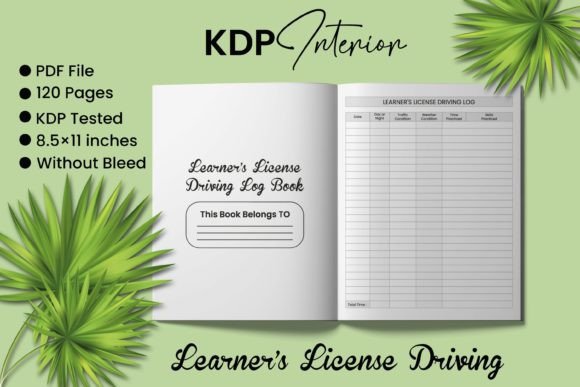
For those creating or publishing their own materials, such as instructors or small businesses, ready-made interior templates offer a significant alternative to designing a log book from scratch. A product offering instant download of an exclusive Learner's Driving Log Book KDP Interior represents a specialized resource in this space. These products are tailored for the Amazon Kindle Direct Publishing (KDP) platform, providing a formatted file ready for upload and sale as a physical paperback or notebook.
The practical strengths of such a download are evident in its specifications. An offering that includes an 8.5×11 inches PDF file at 300dpi ensures professional print quality. The inclusion of a JPG file and a high-resolution interior allows for flexibility if the design needs to be adapted for other uses. A total of 120 pages typically provides ample space for many months of logging, while an interior without BLEED is correctly configured for KDP's printing guidelines. The fact that the files are compressed into one ZIP file and are tested on Amazon KDP speaks to a focus on user convenience and reliability, reducing the technical barriers for publishers.
When a Pre-Designed Log Book Interior Is the Right Fit
This type of downloadable product is optimally suited for a specific user: someone who wants to publish or utilize a professional-grade Learner's License Driving Log Book without investing time in graphic design and page layout software. It is a practical solution for driving schools wishing to provide branded materials to their students, or for entrepreneurs looking to add a niche product to their KDP catalogue. The tradeoff is one of customization versus speed. While the interior is professionally formatted and ready, it may not be fully unique if sold publicly by many publishers. However, for private use or for publishers satisfied with a high-quality generic design, it represents an efficient alternative.
If your need is for a single, personal copy, purchasing an already printed log book or using a free template from a government website might be more cost-effective. But if your goal is to produce multiple copies, sell a log book, or ensure a design that meets exact commercial printing standards, the downloadable KDP interior becomes a compelling option. Its value lies in bypassing the complex preparation stages, providing a tested foundation.
Decision Factors: Choosing Your Recording Solution
Selecting the right method to document your learning hours involves weighing several factors. First, consult your local licensing authority's rules. Some jurisdictions mandate a specific format or require a signature in each entry, which strongly leans toward using a physical Learner's License Driving Log Book. Second, consider your learning environment. If you have multiple supervising drivers, a unified, portable book is often simpler than managing digital access. Third, think long-term. This log may be submitted for your license and then kept as a memento; a sturdy, well-made book can serve both purposes.
For publishers or creators, decision factors shift to production quality and platform compliance. The resolution of the files (300dpi), the inclusion of all necessary formats (PDF, JPG), and confirmation that the files were tested on Amazon KDP are critical indicators of a product that will perform as expected. These details reduce the risk of upload errors or poor print results, which are common limitations with untested, amateur designs.
Alternatives and Their Best-Fit Situations
The landscape of driving log solutions includes several alternatives, each with its own best-fit scenario. Official log books provided by your state's Department of Motor Vehicles (DMV) are often free and guaranteed to be accepted. They are the safest choice for compliance but may be basic in design. Commercial, pre-printed log books purchased from bookstores offer more aesthetic variety and sometimes extra features like tips or diagrams. These are excellent for learners wanting a more guided experience.
As discussed, digital apps or templates serve tech-savvy users who prefer integration. Lastly, the downloadable KDP interior product fits a niche but important need: that of the creator or publisher. It is not an alternative for a learner seeking one copy, but it is a powerful alternative for someone aiming to *provide* many copies. Understanding these distinctions helps align your choice with your specific role—whether you are the learner, the supervisor, or the supplier.
The Practical Benefits of a Structured Log
Beyond mere compliance, using a dedicated Learner's License Driving Log Book yields practical learning benefits. The discipline of recording each session encourages regularity and accountability. Reviewing past entries allows a learner and supervisor to identify patterns—perhaps noticing that certain maneuvers need more practice in specific conditions. This structured reflection can accelerate skill acquisition. Furthermore, a well-kept log book provides a tangible history of progress, which can be motivating during the sometimes lengthy learner period.
When the log book is designed with clarity and ample space, it reduces the friction of the recording process. A cramped or confusing layout becomes a daily annoyance, whereas a thoughtful layout makes the task quick and straightforward. This usability aspect is a significant strength of any professionally conceived product, whether you purchase a printed book or download an interior to print your own.
Ultimately, the choice of how to record your driving practice hinges on your specific requirements for compliance, convenience, and quality. A Learner's License Driving Log Book, in its physical form, remains a robust and reliable standard for most individual learners. For those looking to produce or publish such a book, the availability of tested, high-resolution interior files represents a specialized tool that can turn a concept into a professional product efficiently. By evaluating the tradeoffs between different formats and purposes, you can select the resource that best supports your journey from learner to licensed driver, or from idea to marketplace.